Tag Archives: cast cover

Cover Up That Bunionectomy Cast

bunion-bunionetteWhat is a bunion?  Bunions are PAINFUL and can be a common problem people experience as a bony protuberance at the base of the big toe.  When you have a bunion, the big toe angles in toward the other toes, a condition commonly known as hallux valgus.  They are most common among women and often caused by unsuitable footwear.  Genetics can be a factor, too!

Considering having a Bunionectomy?  Having any elective surgery can be a difficult decision.  About.com Orthopedics offers some great info on deciding when to proceed with bunion surgery, what to look for, and issues to consider before making your final decision.

Bunion Cast Cover-Leopard

Legz! in “Classic Cheetah”

CastCoverz! Legz! cast covers will cover up that big, bulky cast after bunion surgery, protecting your other leg and furniture & sheets from scratching and snagging!  You’ll be giving your cast some personality, too!  With many fabrics to choose from, there’s sure to be a cover that’s perfect for you, including fun and festive holiday fabrics, which are currently on promotion for 10% off, thru December 20, 2013.

Orthopedic Products to Make Your Recovery Easier

Guest Blog Post by Goodbye Crutches:

So, you’re stuck on one foot for the time being. And you’re not too happy about it, either! With today’s modern technology on your side, there are many products that can help make your recovery easier. You don’t have to suffer through it, with no comforts whatsoever. Here are a few items that can help your pain, mobility, comfort, and life in general, as you recover.

Item #1:  Alternatives to Crutches 

If hobbling around on crutches is simply too hard, take heart! You don’t have to! You can look into one of three alternatives to crutches from Goodbye Crutches, that can help you get where you want to go.Goodbye Crutches Some allow you the use of your hands, too. The Hands Free Crutch, for example, straps right to your bad leg and lets you walk much like normal, with both of your hands free at all times. The Knee Walker, on the other hand, is a wheeled device that lets you retain your balance while you scoot yourself from place to place. And the Seated Scooter is a great option for those who want to get in as much rest as possible, while moving around at the same time.

Item #2:  CastShield Waterproof Protector
Taking a shower with a cast is quite an ordeal. You know you aren’t supposed to get it wet, but how can you do that and still get clean? The CastShield allows you to cover your cast, so you don’t get moisture beneath it. It is reusable and comes in a set of two, so you can keep one in the shower and one in your travel bag.

Item #3:  Shower Bench
Once your cast is covered, you can safely shower without getting your cast wet, but that still doesn’t help you balance while you lather, rinse and repeat. The Adjustable Shower Bench, however, allows you to sit and shower, so you don’t have to worry about slipping or just getting off balance. You can finally enjoy your showers again without additional hazards.

Item #4: CastCooler
If your cast starts to itch and smell, in the past the only thing you could do was wait it out and suffer. Some people would even take a wire hanger and stick it down the cast, but that certainly isn’t a good idea. Today, there’s the CastCooler! This device attaches to your cast and your vacuum and it sucks the moisture out from beneath the cast. It leaves you with a cool, fresh, clean feeling.

Item #5: Cozy Toe Warmer
If you have a cast and your toes stick out on the end, they are exposed and cold during much of your recovery. You could try to stretch a sock over your toes, but those socks are hard to get on and off and they don’t really do a good job as it is. The Cozy Toe Warmer fits over your toes like a slipper and straps around the back of your cast with adjustable Velcro. It keeps your toes dry and warm and can even be washed if you get it dirty.

Item #6:  CastCoverz!

aboutusseptember2013final-wo-200

If you’re wearing a cast, boot, splint, brace, or sling, CastCoverz! provides fun and functional products that cover orthopedic devices, offering much needed comfort from scratching, snagging, and so much more. While on crutches, CrutchWear is a must to make those standard-issue crutches more bearable. No matter what the orthopedic event, CastCoverz! has got you covered!

Different Types of Bone Fractures

Broken bones (also known as fractured bones) are common for both children and adults.  A broken bone occurs when a force exerted against the bone is stronger than it can structurally withstand.  Most fractures are usually due to a fall, athletic activity, or car accident.  The wrist, ankle, and hip are the most common sites for bone fractures and treatments include setting the broken bone in a cast or surgically pinning the bones back together.

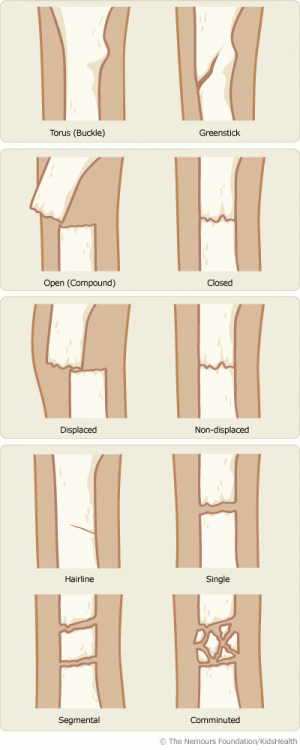
There are many different types of bone fractures, but they are generally placed into one of four different categories:  Displaced, non-displaced, open, and closed.

Here are several different types of common bone fractures…

  • Torus fracture (or buckle fracture) – commonly seen in children due to softer bones, a torus fracture occurs when one side of the bone may buckle upon itself without disrupting the other side, also known as an incomplete fracture
  • Greenstick fracture – a small, slender crack in the bone, which is more common in children because of their flexible bones
  • Open or compound fracture – the broken bone breaks through the skin
  • Closed or simple fracture – the broken bone has not pierced through the skin
  • Displaced fracture – the bone snaps in two or more parts and are no longer aligned
  • Non-displaced fracture – the bone cracks partly or completely but maintains proper alignment
  • Hairline fracture (or stress fracture) – often occurs from repetitive stress to the same bone
  • Single fracture – a single break in one bone
  • Segmental fracture – a fracture in two parts of the same bone
  • Comminuted fracture – the bone is shattered into multiple small pieces

Although no one ever plans on suffering a broken bone, CastCoverz! is here to help you Feel Better, so you Heal Better!  CastCoverz! provides fun and functional products that comfort orthopedic patients; from cast, brace, and walking boot covers to colored crutches, crutch covers, and waterproof cast protectors, we’ve got you covered!

How to Know if a Bone is Broken in Adults

Did you know you are born with over 270 bones?  But, many of these fuse together as you grow, leaving a total of 206 separate bones in an adult!  Broken bones (also known as fractured bones) are common for both children and adults.  In our previous post, “How to Know if a Bone is Broken in Children“, we learned that most fractures are usually due to a fall, athletic activity, or car accident.  In addition, some people can be more prone to breaks because of genetic conditions or bone disease that weakens bones.

An X-ray image of a fractured radius showing the characteristic Colles’ fracture with displacement and angulation of the distal end of the radius.

Adults most commonly fracture leg and ankle bones, along with forearms.  One-sixth of all fractures treated among adults are known as Colles’ fractures.  A Colles’ fracture is a fracture of the distal radius in the forearm with dorsal (posterior) displacement of the wrist and hand (commonly referred to as a “dinner-fork” or “bayonet” fracture.) They are most common in the elderly and often seen in people with osteoporosis.

A doctor may suspect a fractured bone simply based on the appearance of the injured area.  Following is a list of signs and symptoms you can use to help determine whether or not a bone is broken in an adult.

How to know if a bone is broken in adults:

  • Is the area swollen and bruised?
  • Is the limb hanging at a funny angle or look out of place?
  • Is the bone sticking out through the skin?
  • Did the injured person feel or hear anything crack?
  • Can they move the injured area?
  • Does it hurt when touched?
  • Most importantly, consult a doctor.  X-rays of the injured area will usually confirm the diagnosis of a broken bone, although stress or hairline fractures can be difficult to detect on an x-ray.  If the x-ray does not show a fracture, but after 7-10 days, there is still pain or something just doesn’t feel quite right, do not hesitate to ask for another.  By that time, calcium “ribbons” will be visible.  Calcium ribbons occur only when a bone has broken or suffered a Greenstick fracture (a mild bone fracture or bone bend.)

If you suspect a broken bone, do your very best to keep the injured area still, until you know for sure what type of orthopedic injury you are dealing with.  Once you know you’re dealing with a fracture and have been casted, you’ll definitely want to visit CastCoverz!  CastCoverz! provides fun and functional products that comfort orthopedic patients, from cast covers and walking boot covers, to colored crutches and CrutchWear crutch accessories, we’ve got you covered!  OH, and don’t forget you’ll need to keep that cast DRY with DryPro waterproof cast protector, and for some much needed relief from that itchy, stinky cast, try CastCooler!

Feel Better, Heal Better, and be sure to check out our previous post, “How to Know if a Bone is Broken in Children.”